According to the global financial services major, inflation may remain sticky, with a possible El Nino effect on the monsoon likely to push up food prices and geopolitical uncertainties seen pumping up global commodity rates.

Factory output, measured in terms of Index of Industrial Production, showed an improvement mainly because of an uptick in mining and manufacturing production and larger offtake of capital goods.

Pulses cropping has jumped to 39.4 per cent above 2015 levels.

Food prices are also expected to move up due to the poor monsoons.

Monetary Policy- Easing expected to happen later this financial year.

Inflation dipped to a five-month low of 5.19 per cent in July mainly on account of decline in prices of some food articles, vegetables and protein rich items.

Prices have continued to move up in Delhi's markets, wholesale and retail, on supply worries and spoilage due to record cold weather.
The forecast of deficient monsoon rainfalls scared farmers.

Inflation in food articles inched up to 0.69 per cent in September.

In the current fiscal so far, retail inflation stabilised around 5 per cent, while wholesale price-based inflation averaged around 2.9 per cent during April-December.

In many states, aggregators operate without a licence; in others, with the risk of the licence being revoked by any regional transport office on the slightest pretext.
In December 2014, it was (-)0.50 per cent.

The RBI, which has been keeping rates at an elevated level citing high inflation, wants it to come down to 6 per cent by January 2016.

Spiralling prices pinched the pocket of consumer as edible oil, fuel and many other commodities turned dearer this year amid pandemic-induced disruptions but the inflationary pressure is anticipated to ease, though marginally, in the coming months. As consumers, at retail as well as wholesale levels, are willy-nilly learning to live with the new normal of curbs to contain the spread of coronavirus infections, experts are of the view that elevated inflation is likely to stay longer. After dealing with the devastating blows from the second COVID wave, especially during the April-June period, the economy is well on the revival path but the emergence of Omicron might unsettle the recovery trajectory in the short term.
The reading for June WPI inflation was revised to 5.66 percent from 5.43 percent earlier.
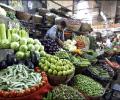
Industrial output had slowed to 5-month low of 2.1% in March.

A careful reading of the national income accounts suggests that after a strong recovery from the pandemic, there has been a significant ebbing of dynamism over the last three quarters to more modest levels recently, note Arvind Subramanian and Josh Felman.
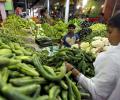
Inflation rate in fuel and power segment was (-)16.50 per cent.

Benchmark equity index Sensex and Nifty gave up early gains and ended lower on Monday as investor sentiment was hit due to unabated foreign fund outflows and losses in index heavyweights Reliance Industries and HDFC Bank. The 30-share BSE Sensex declined 168.21 points or 0.28 per cent to settle at 60,092.97 as 15 of its constituents dropped. The barometer opened higher and touched a high of 60,586.77 in morning session. Later in the day, it fell 297.35 points or 0.49 per cent to 59,963.83.

'Spending by the middle class is limited with a focus on savings. However, there is buoyancy at the top-end.'
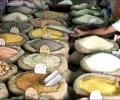
Inflation moderates, but a rate cut is unlikely.

The price of export quality lady's finger, for example, shot up 150 per cent in two weeks to close on Thursday at Rs 40 a kg against Rs 16 a kg on September 16 in the Agricultural Produce Marketing Committee, Vashi, near Mumbai.

Retail inflation was at a 25-month low of 8.1 per cent in February.

As many as 34 new drugs were added to and 26 dropped from an updated list of essential medicines on Tuesday, with the government saying this will reduce "patients' out-of-pocket expenditure". The National List of Essential Medicines (NLEM 2022) has 384 drugs, up from 376 in 2015. "Drafting this list is a lengthy process, and around 350 experts from across India have held over 140 consultation meetings to draft the NLEM 2022," Union Health Minister Mansukh Mandaviya said.

In May, price growth for drugs was in negative territory at (-)1 per cent

Costlier fruits and vegetables such as onions and tomatoes pushed retail inflation to a nine-month high of 11.24 per cent in November, making it harder for the Reserve Bank to lower interest rates.
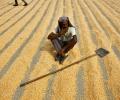
Recommends delisting of chana futures, open to lowering sugar import duty

Overall, volume growth is likely to be in the range of 3-8 per cent for two-wheelers and 5-7 per cent for passenger vehicles owing to healthy demand from urban and rural areas and pending order books.

The country's gross domestic product (GDP) growth is likely to be 8.8 to 9 per cent in the current financial year, driven by agriculture and industry sectors, Care Ratings said in a report. The country's economy had contracted by 7.3 per cent in fiscal 2020-21. The agency said the outlook for the Indian economy on almost all counts in FY22 would look seemingly better than FY21 on account of the negative base effect.

The S&P BSE Sensex dropped 1 points to end at 26,396 and the Nifty50 slipped 2 points to end at 8,109.
.jpg)
As on Monday, the prices of many vegetables had fallen as much as 50% compared with those a month before, due to increased supply, following the arrival of winter crops in the markets.

Prime Minister's Economic Advisory Council (PMEAC) Chairman C Rangarajan may have found the Reserve Bank of India (RBI)'s inflation projections on the higher side, but independent experts agree with the central bank and expect both wholesale and retail prices to remain high.

The HSBC/Markit Purchasing Managers Index for the services industry inched up to 47.2 in November from 47.1 in October, the fifth sub-50.0 reading and indicated an output contraction across the Indian service economy.

The government is confident of meeting the fiscal deficit target of 5.9 per cent of gross domestic product (GDP) and the nominal GDP target of 10.5 per cent despite pressure in the initial months of FY24, Economic Affairs secretary Ajay Seth told Business Standard. Normally the initial months of any financial year see proportionally a higher fiscal deficit because the expenditure is evenly paced while revenue picks up in the later months, he said. "This year the proportional fiscal deficit so far is much closer to the target than in most other years.

In contrast with their strong performance in 2020 and 2021, pharmaceutical and healthcare funds experienced a decline in 2022, with returns plummeting by an average 9.8 per cent. This trend has continued in the current year, with year-to-date return remaining in the negative (-4.9 per cent). In the past three months, pharma funds have been hit hard, experiencing a 7.9 per cent decline.

Inflation data and global trends would be the major driving factors for the equity markets this week which after a record-breaking run took a breather in recent trades, analysts said. The overall market sentiment remains positive, supported by improving economic data and earnings but higher valuations can trigger bouts of profit booking, they said further. During the last week, which the 30-share BSE benchmark rose by 175.12 points or 0.30 per cent.

Fourth quarter earnings of blue-chips such as Infosys, TCS, Wipro, RIL and inflation data for March will dictate the trend on the bourses in a holiday-shortened week ahead, experts said.

Prices of food articles contracted by 3.47 per cent in June on a yearly basis. Vegetable inflation stood at (-)21.16 per cent.

The HSBC India Manufacturing Purchasing Managers' Index for the manufacturing industry climbed from 49.6 in October to 51.3 in November on the back of a rebound in new orders and output.

The change from wholesale to retail inflation as an anchor means that the weightage of diesel in inflation has decreased
 © 2026 Rediff.com - Advertise with us - Disclaimer - Privacy Policy - Sitemap - Feedback - About us - Terms of use - Grievances